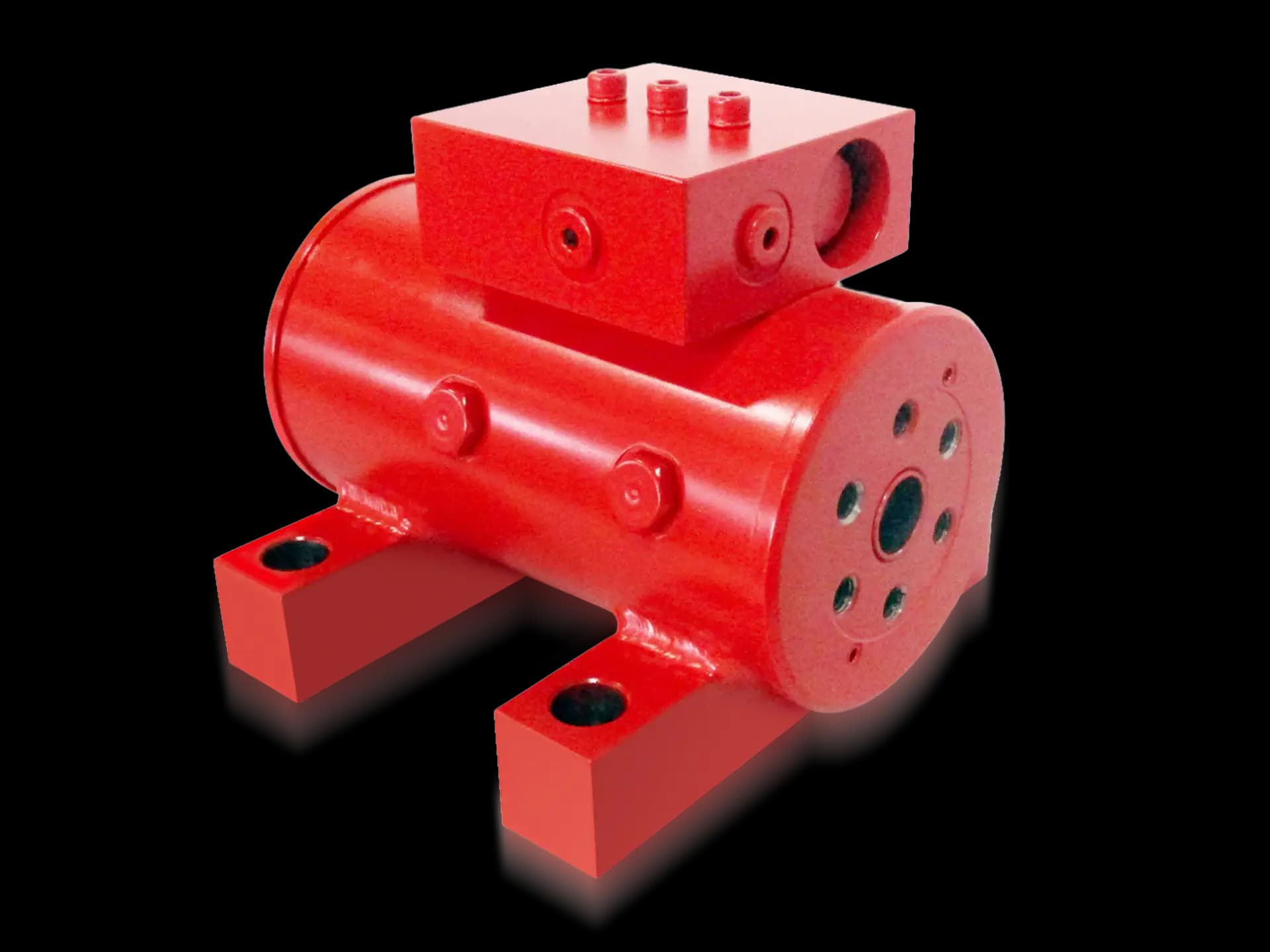
What is a linear hydraulic cylinder?
A hydraulic cylinder uses piston-rod extension and retraction to convert hydraulic energy into linear thrust. It is suited to long-stroke, fixed-direction push-pull applications and is one of the most widely used hydraulic components in industrial machinery.
- Typical application scenarios
- Processing machinery: workpiece clamping and slide-table feed
- Construction machinery: formwork pressing and lifting
- Automation equipment: press-fitting, transfer and positioning
What is a rotary actuator?
A rotary actuator converts hydraulic energy into rotary torque within a limited angle. The output angle is usually between 90° and 360°. Its installation space is compact, its structure connects directly to the output shaft, and it does not need a crank mechanism for conversion.
- Typical application scenarios
- Excavator-arm flipping mechanisms
- Work-platform swing on aerial work vehicles
- Drill-angle adjustment on mining machinery
Linear vs. rotary: see the difference at a glance
Selection comparison: the duty determines the selection. Note: Operating Frequency means the number of action cycles a hydraulic actuator completes per unit of time in the actual duty—the speed at which it is driven back and forth.
| Selection | Linear hydraulic cylinder | Rotary actuator |
|---|---|---|
| Motion form | ✔ Linear push-pull | Rotary swing |
| Rotary motion | ❌ Not suitable | ✔ Native output |
| Stroke length | ✔ Long stroke | Limited angle |
| Installation space | Requires piston-rod extension space | ✔ Compact |
| Torque output | Requires crank conversion | ✔ Direct output |
| Seal life | Good for axial load | ✔ Good for rotary duty |
| Typical frequency | Low to medium frequency | High-frequency swinging possible |
⚠️ Most common selection error: using a linear cylinder for rotary motion
Some designs use a linear cylinder with a crank mechanism to simulate rotary motion in order to simplify procurement. This causes the seals to carry side loads (a direction outside the design load), accelerates wear and shortens oil-seal life, ultimately causing premature failure under high-load conditions. This is not a product-quality problem; it is a selection problem.
Frequently Asked Questions
What is the fundamental difference between a linear hydraulic cylinder and a rotary actuator?+
A linear hydraulic cylinder outputs linear thrust for fixed-direction push-pull motion; a rotary actuator outputs rotary torque for limited-angle swing. The fundamental difference is the output motion form, not pressure rating or flow rate.
What happens when the wrong hydraulic actuator is selected?+
The most direct result is early seal failure, causing leakage and unstable pressure, which then triggers unplanned downtime. Downtime costs—labor, production loss and repair parts—are often several times the cost difference of correct selection.
Can a rotary actuator replace a hydraulic motor?+
A rotary actuator suits limited-angle swing motion (usually ≤ 360°); a hydraulic motor suits continuous rotation. Their application logic is different and they cannot be directly substituted. The decision must be based on rotation angle, frequency and torque requirements.
How does Ashun help customers make a precise selection?+
Ashun engineers evaluate load, operating angle, action frequency and environmental conditions, then verify the selection through laboratory testing before shipment to ensure stable operation in demanding conditions.
Ashun's selection promise
Ashun Fluid Power has specialized in hydraulic-component manufacturing since 1984. Its complete range of linear hydraulic cylinders and rotary actuators is designed for the duty and shipped only after laboratory pressure-cycle testing.
The harsher the environment, the more stable Ashun performs. This is not a slogan; it is the acceptance standard for every unit that leaves the factory.